What the stars look like at 900 metres
No lights for thirty kilometres, dry air and a sky that fills from edge to edge. A guide to stargazing in the valley, and what to look for in each season.
 Khalid Al-HarbiHead naturalist and guide
2 min read
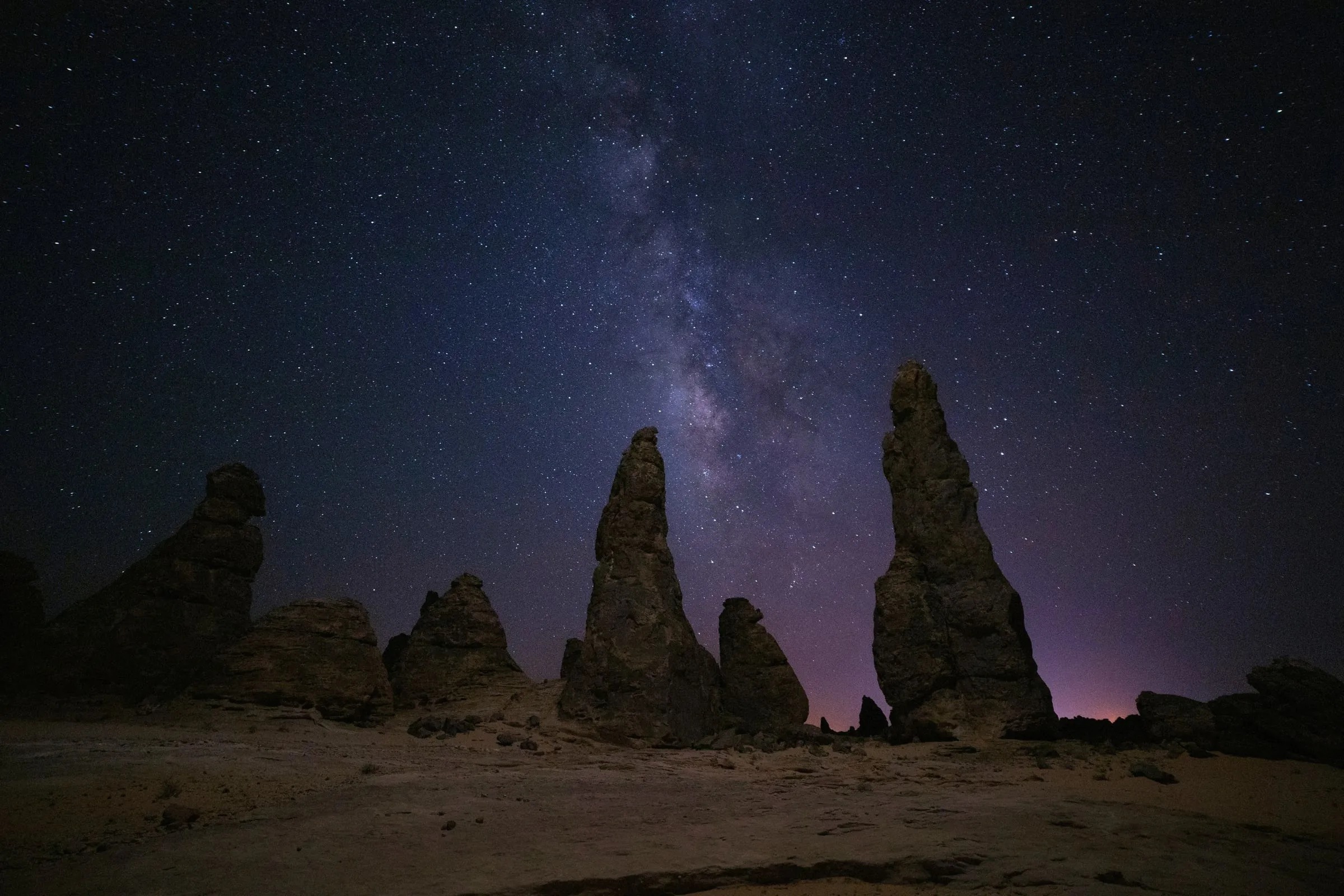
The first night most guests step out onto their terrace after dinner, they stop talking. The resort sits at around 900 metres, in dry air, with no town lights for thirty kilometres in most directions. On a moonless night the Milky Way casts a faint shadow.
Why the sky is so clear here
Three things make the valley one of the best places to see stars in Arabia. The altitude puts you above some of the haze that hangs over the coast. The air is dry, so there is little moisture to scatter starlight. And the canyon walls block what little glow comes from AlUla. We keep the resort’s own lights low and warm, pointed down, and switch the pathway lights off after eleven.
When to come
The best skies are between October and March, when nights are cool and still. Around the new moon, the Milky Way rises over the cliffs to the south-east in the early evening. In summer the sky is just as dark, but the warm air shimmers, and you will want to stargaze after ten when the rock has cooled.
Check the moon before you book if stars matter most to you: a full moon lights the canyon beautifully, but drowns out all but the brightest stars.
What to look for
- Winter: Orion overhead, with the reddish Betelgeuse and blue-white Rigel at opposite corners, and the Pleiades, a tight cluster of seven stars to the naked eye and dozens through binoculars.
- Spring: Leo rising in the east, and on clear nights the faint wedge of the zodiacal light after sunset.
- Summer and autumn: the bright core of the Milky Way in Sagittarius, low in the south, and the Summer Triangle overhead.
- All year: satellites, which you will start to count after five minutes, and on most nights at least one bright meteor.
Arabic names are everywhere in the sky. Aldebaran, Betelgeuse, Rigel and Altair all come from the Arabic astronomers who mapped these stars a thousand years ago, and our astronomer will tell you what each name means.
Stars over the valley
Three nights a week we take a telescope, blankets and hot drinks up to the dune above the resort. Our astronomer shows you Saturn’s rings when they are up, the craters along the moon’s edge, and a galaxy two and a half million light years away that is just visible to the naked eye. The session lasts about ninety minutes and is included in your stay.
If you would rather stay home, every Dune Suite and Sky Villa has a sky deck on the roof, with a daybed and blankets. Ask your host for a star chart and a red torch, and give your eyes twenty minutes to adjust.
Written byKhalid Al-HarbiHead naturalist and guide, with us since 2021